Give your game the voice it deserves
Advertisement:
I recently posted on my socials that in 2026, it’s time games finally starting using voice overs in addition to the text on screen which is often painstakingly long to read, and as I had expected, various game developers DM’d to say that they prefer reading text on screen and VO is distracting for them. I think I have a food for thought for them and for everyone in the industry with a similar mindset, so here you go:
I hope the pattern is clear. Games have Settings to let the player choose what is most comfortable to them. Even from an accessibility standpoint, one might prefer dull brightness when playing at night. These customisations are already IN place for decades. Which means if you’re not exploring VOs in games, there are very very high chances you might have gotten used to the usual industry trend and missed to see a key aspect of a gameplay experience… Quick rant: I will go ahead and also say that if it weren’t for some games that added settings to set volume levels for music and sound effects separately, there are chances that most ‘trend-followers’ would have discarded that idea in the name of it requiring extra effort to build an audio mixer! And we’re back…
Maybe in the past, the lack of timeline was an issue but for many years now that has become an excuse. Audio middleware, artists with their own legal generative VO models etc exist. Implementation is possible faster than ever and, for the millionth time, audio is the least effort high impact element.
If generative stuff is not a preference, you can always use TTS to unblock implementation and replace files (that hardly takes more than 10 seconds) when official VOs are back.
And that preference you have to mute VOs — well, give a button somewhere in the UI to toggle it off. But let your stories & characters finally speak. Let them have a voice.
Make your game full of an engaging experience. An analogy I use in my game audio workshops for game designers is this:
Of course the game context matters a lot and I'm not advocating to have voice overs for the sake of it or everywhere. But skipping it altogether for those narratives where the story is all about characters, I think a lot more has to be done in this direction. I should emphasise that this might be a learning curve for a few, even for veteran game developers. But just because something has been avoided for decades doesn’t mean it should never get the attention it needs. I hope you are slightly convinced to consider it, so here are some wins that voice overs can bring you: These are just a few ideas which I'm sure many in your game design team must have thought of too. For some reason, you didn't go through with it. Guess what? The time has come! What are your thoughts? I'd love for this to start a conversation and bring voices to the table for discussion.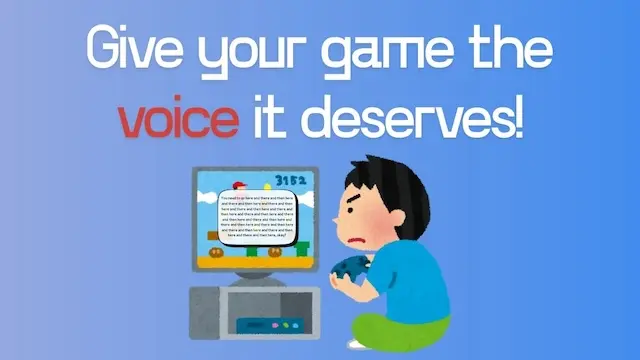
“Imagine you have a color palette for your painting project and it has everything, except blue. You will be able to draw most things in the world like desert and forest, and maybe you’re okay with that. But someday, you will want to draw sky and water. And that’s when the blue will help. Audio is that one thing that’s missing in most game dev’s understanding. Add it. Learn how to use it. Experience it. You might end up using it more than you thought you would!”


Written by Prashant Mishra
Audio Developer Conference (ADC) | Universal Category System (UCS) | Game Audio India | National Institute of Design | Music Hack Day India | Music Tech Community | Previously collaborated with & contributed to School of Video Game Audio | Disney Publishing Worldwide (DPW) | ISMIR | Osmo | Airwiggles | epic! and more